The backlink price market is full of contradictions. Two websites with almost identical SEO metrics can charge completely different amounts for publishing an article. One publisher asks $40, another demands $450, and a third refuses to discuss prices until a potential customer explains their industry.
At first glance, this pricing system appears chaotic. But look more closely, and a fascinating picture emerges.
Behind every backlink is a small commercial ecosystem involving website owners, content creators, outreach specialists, agencies, and intermediaries. Each participant influences the final amount a customer pays.
Some prices reflect genuine editorial work and access to valuable audiences. Others are inflated by unnecessary middlemen or impressive-looking metrics that reveal surprisingly little about a website's actual quality.
So what determines the real value of a backlink, and how can businesses avoid paying premium prices for ordinary placements?
Inside the Backlink Marketplace: Who Actually Sets the Price?
The first discovery is that backlink prices aren't established by a central authority or standardized industry formula.
Individual publishers decide what they charge.
A website owner might consider several factors when setting publication fees:
• Monthly traffic and audience characteristics
• Website reputation and publishing history
• Domain Authority or Domain Rating
• Editorial workload and content requirements
• Demand from advertisers and SEO agencies
• Industry specialization and geographic market
• Whether the article is written by the publisher or supplied by the customer
Some publishers maintain fixed rate cards. Others negotiate prices individually.
And some have no established pricing strategy at all.
Consider a hypothetical technology blog receiving several sponsored article enquiries each week.
Initially, its owner charges $50 per publication. As demand increases, the fee rises to $150.
The website hasn't necessarily become three times more valuable.
The publisher has simply discovered that customers are willing to pay more.
This is one reason backlink price comparisons can be surprisingly difficult.
The Middleman Effect: How a $60 Publication Becomes a $250 Backlink
One of the less visible aspects of the industry is the number of intermediaries involved.
Imagine a website owner charging $60 to publish an article.
An outreach specialist discovers the opportunity and offers it to an SEO agency for $110.
The agency then includes the publication in a client campaign at an effective price of $250.
The final customer pays more than four times the publisher's original fee.
Does that mean the customer has been cheated?
Not necessarily.
The intermediaries may provide valuable services, including website evaluation, content writing, editorial coordination, project management, and reporting.
But it demonstrates why the final cost of backlinks can differ substantially from the amount received by the publisher.
A higher price is reasonable when it covers identifiable work.
Problems arise when customers pay substantial markups without understanding what additional value they're receiving.
Transparency is therefore an important consideration when selecting a provider.
The Domain Rating Trap: When Numbers Become Expensive
Domain Rating, commonly abbreviated as DR, is one of the most frequently discussed metrics in backlink trading.
A website with DR 70 may command a considerably higher publishing fee than a website with DR 25.
But what does that number actually tell us?
DR is a third-party metric designed to estimate the relative strength of a website's backlink profile.
It doesn't directly measure editorial quality, genuine readership, conversion potential, or the usefulness of an individual article.
More importantly, Google doesn't use third-party DR scores as an official ranking factor.
This creates an interesting market distortion.
A website with impressive metrics may charge premium prices despite publishing generic articles across dozens of unrelated industries.
Meanwhile, a smaller specialist publication may attract an engaged professional audience while maintaining a relatively modest authority score.
Which offers better value?
For a company selling specialist industrial equipment, the smaller publication could provide more relevant exposure.
The lesson is simple: backlink price shouldn't be determined by authority metrics alone.
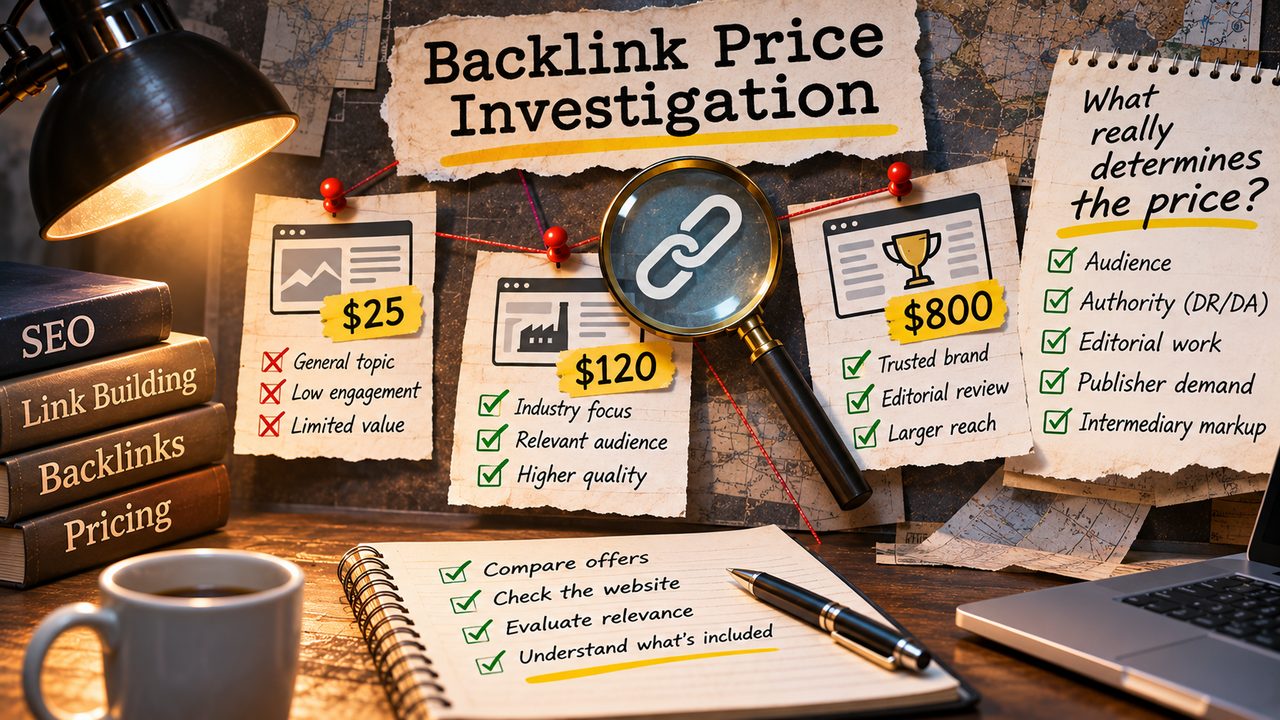
A Closer Look at Three Hypothetical Publishing Offers
To understand the market, consider three fictional websites offering sponsored editorial placements.
Website A: The $25 General Blog
The website publishes articles about travel, finance, pets, technology, and almost every other imaginable subject.
Its content is updated frequently, but individual articles receive little visible engagement.
The publishing fee is attractive.
For a business seeking relevant readers, however, the website may offer limited value.
The main question isn't whether $25 is affordable. It's whether the publication has a meaningful marketing purpose.
Website B: The $120 Industry Magazine
This website focuses on a specific professional sector.
Its articles cover industry developments, practical advice, and interviews with specialists.
The audience is smaller than that of a large general-interest website, but its readers have clear interests.
For a business operating in the same industry, a sponsored article could provide valuable exposure.
The higher backlink price may reflect access to a more relevant audience and stronger editorial requirements.
Website C: The $800 Premium Publication
The third website is an established publication with a recognizable brand and a substantial audience.
Its editorial team reviews submissions carefully, and publication opportunities are limited.
The price reflects the publisher's reputation, audience reach, and editorial work.
However, even an $800 placement needs to make commercial sense.
If the publication reaches an audience unrelated to your business, its prestige alone may not justify the expense.
These examples illustrate an important principle: the most expensive backlink isn't necessarily the most valuable one.
The Hidden Economy of Guest Posts
Guest posting is often presented as a straightforward transaction.
A company supplies an article, the publisher approves it, and the content appears online.
In practice, the process can involve several costs.
Someone must identify suitable websites, establish contact, negotiate publication conditions, prepare the content, and verify the final article.
The complexity increases when the publisher requires original research, expert commentary, or specialist writing.
This explains why link building services cost can exceed the publisher's basic fee.
But there's another side to the story.
Some websites accept almost any commercial article provided the customer pays.
When editorial standards disappear, the distinction between a genuine publication and a link-selling operation becomes increasingly blurred.
For businesses evaluating opportunities, editorial scrutiny can be a positive signal.
A publisher willing to reject irrelevant or poorly written content may be protecting the quality of its website.
Are Expensive Backlinks Actually Better?
The evidence needed to answer this question is more complicated than a simple price comparison.
A higher fee may indicate stronger editorial standards, a valuable readership, or a respected publication.
It may also reflect aggressive pricing, high demand, or multiple intermediary markups.
None of these factors guarantees better search rankings.
Consider the experience of a fictional marketing manager reviewing a $600 publication offer.
After examining the website, she notices that most articles receive almost no social engagement and that the publication covers hundreds of unrelated commercial topics.
She asks the provider:
"What exactly makes this placement worth $600?"
The answer focuses entirely on the website's Domain Rating.
That should prompt further investigation.
A relevant publication should offer more than one impressive number.
Businesses should consider audience relevance, editorial quality, organic visibility, publication conditions, and potential referral traffic.
The cost of link building becomes easier to justify when the expected marketing value is clearly understood.
How Backlink Brokers Influence Market Prices
Backlink brokers connect customers with publishers.
Their role can be useful because maintaining relationships with hundreds or thousands of websites requires time and organization.
However, broker pricing models vary.
Some apply a fixed markup to each publication.
Others negotiate volume discounts with publishers and retain part of the difference.
Certain providers bundle content writing and campaign management into the final price.
For customers, the important question is whether the complete offer represents fair value.
A broker charging $180 for a placement that costs $100 directly may still be attractive if the service includes professional writing, website verification, and reliable coordination.
On the other hand, paying a large premium for a basic publication with no additional service may be difficult to justify.
Comparing multiple offers can reveal significant differences in link building pricing.
The Risk Behind Extremely Cheap Backlinks
At the opposite end of the market are offers promising hundreds or thousands of links for remarkably small amounts.
These services often emphasize quantity rather than publishing quality.
Some rely on automated submissions, low-quality directories, or networks of websites created primarily to distribute links.
Such placements may offer little genuine audience exposure.
There is also a search engine compliance issue.
Google considers buying or selling links for ranking manipulation a violation of its spam policies when those links pass ranking credit.
Paid advertising and sponsored placements should be appropriately qualified using attributes such as rel="sponsored" or rel="nofollow".
This distinction is important because businesses should not assume that purchasing backlinks guarantees ranking improvements.
A publication can still provide marketing value through relevant content, referral traffic, and brand exposure.
But the price should reflect those benefits rather than promises of manipulating search results.
How to Investigate a Website Before Paying
You don't need to be a professional SEO analyst to perform basic checks.
Start by opening the website and reading several recent articles.
Does the content appear useful? Is the website focused on recognizable topics? Are articles written for real readers?
Next, examine the publication's history.
A website that has maintained consistent editorial coverage over several years may deserve closer consideration than one suddenly publishing dozens of unrelated sponsored articles.
If SEO tools are available, review organic traffic estimates, referring domains, and visibility trends.
Pay attention to unusual patterns.
A high authority score combined with negligible relevant search traffic isn't automatically evidence of poor quality, but it warrants further examination.
Finally, inspect the proposed publishing conditions.
Ask whether the article will remain accessible, whether revisions are possible, and how sponsored links are handled.
These checks help businesses make more informed decisions about backlink price.
The Real Cost of a Bad Backlink Purchase
Let's examine a simple hypothetical calculation.
A business purchases ten publications at $100 each.
Its total investment is $1,000.
After publication, the company discovers that most websites have little relevant readership and that several articles contain generic content unrelated to its services.
The campaign delivers the agreed number of links, but produces almost no referral visits or meaningful audience exposure.
Now consider another business spending the same $1,000 on fewer, carefully selected publications.
Its articles appear on websites read by potential customers.
Even without guaranteed ranking improvements, those publications may create opportunities for enquiries, brand recognition, and professional relationships.
The difference isn't necessarily the link building cost.
It's the quality of the purchasing decision.
What the Backlink Market Reveals About Pricing
After examining publishing fees, intermediaries, SEO metrics, and editorial standards, one conclusion becomes clear.
There is no universal formula for determining a fair backlink price.
The market is shaped by supply, demand, publisher reputation, audience relevance, and the services included in each transaction.
Businesses should therefore avoid treating backlinks as interchangeable products.
A link appearing within a specialist editorial article is not equivalent to an automated placement on an unrelated website.
Likewise, a premium publication isn't automatically worth its asking price.
The most useful comparison is between total expense and expected marketing value.
Frequently Asked Questions About Backlink Prices
What is a reasonable backlink price?
A reasonable price depends on the publishing website, editorial requirements, audience relevance, and included services. Some opportunities cost tens of dollars, while specialist publications can charge hundreds or more.
Why do backlinks from high-DR websites cost more?
Publishers and brokers often use Domain Rating as a pricing indicator. However, DR is a third-party metric and doesn't guarantee editorial quality, relevant traffic, or search ranking improvements.
Can two providers sell placements on the same website at different prices?
Yes. Providers may negotiate different publisher rates, apply different markups, or include additional services such as content writing and campaign management.
Is a $500 backlink worth buying?
Possibly, if the publication offers relevant audience exposure, strong editorial standards, and commercial value. The price alone isn't enough to determine whether the opportunity is worthwhile.
How can I avoid overpaying for backlinks?
Compare offers, examine publishing websites, understand what services are included, and evaluate relevance rather than relying exclusively on SEO metrics.
Final Verdict: What Should a Backlink Really Cost?
The investigation reveals that backlink price is influenced by far more than website authority.
Publisher fees, editorial requirements, industry specialization, audience quality, and intermediary margins all contribute to the final amount.
A $50 publication can be useful. A $500 placement can be disappointing.
The difference often comes down to relevance, transparency, and whether the publication serves a genuine marketing purpose.
Before paying, investigate the website, question the pricing, and understand what you're receiving.
Because in the backlink market, the most expensive mistake isn't necessarily buying a costly link.
It's paying for a publication without knowing why it should matter to your business.