At 9:17 on a Tuesday morning, Michael Turner received an email that would change the way he looked at his small online magazine.
Michael owned a website dedicated to home improvement, interior design, and practical advice for homeowners. He had spent four years publishing articles, improving the website, and building an audience.
The magazine attracted around 18,000 monthly visits. It wasn't a major media company, but it had a loyal readership and a growing collection of useful content.
The email came from an SEO agency.
“Hello Michael, we represent several businesses interested in publishing guest articles. Do you accept sponsored content, and what is your publication fee?”
Michael stared at the message.
He had received similar requests before, but this time he decided to investigate the business behind them.
He had no idea that a single article could involve several different companies, multiple invoices, and a final backlink price considerably higher than the amount he would receive.
The First Offer: $40 for an Article
Michael replied that he was open to reviewing relevant sponsored content.
The agency responded almost immediately.
“We can offer $40 per publication. Our clients provide the articles, so you only need to review and publish them.”
Forty dollars sounded reasonable.
Michael already paid for hosting, website maintenance, and occasional editorial assistance. Additional revenue could help cover those expenses.
But he wanted to understand what he was accepting.
“Are the articles related to home improvement?” he asked.
“Mostly. We work with different advertisers, but we can match topics to your website.”
Michael agreed to review one submission before making a decision.
Two days later, he received an article about choosing energy-efficient windows.
The content was relevant, reasonably well written, and included a reference to a window installation company.
He requested a few editorial changes and asked that the sponsored relationship be disclosed appropriately.
The agency accepted.
Michael published the article and received his $40 payment.
From his perspective, the transaction was straightforward.
But the story didn't end there.
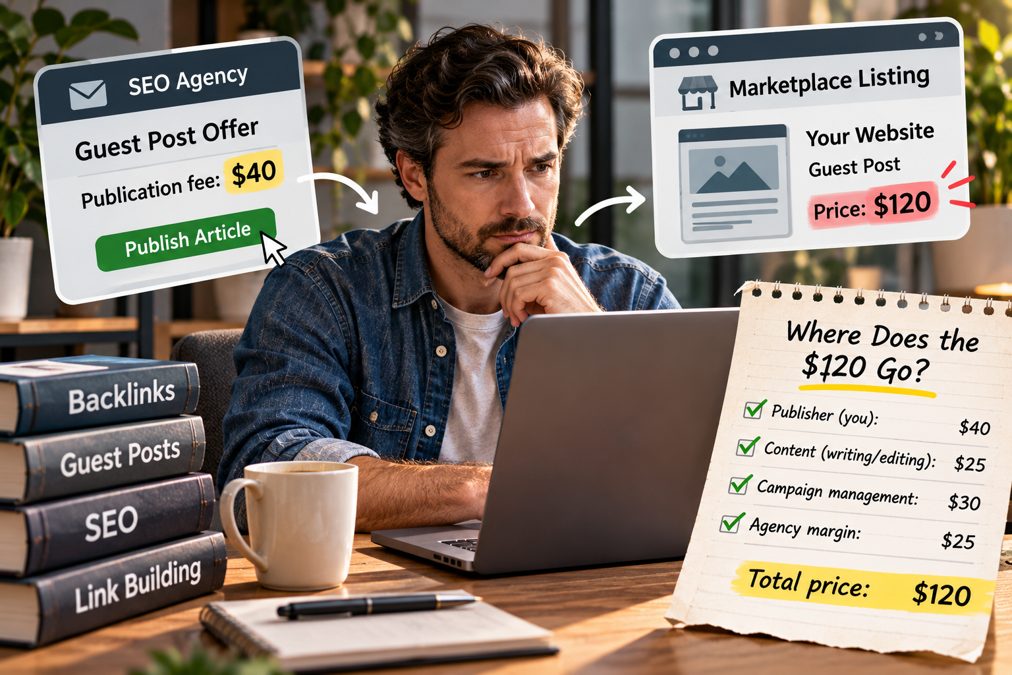
The Discovery: His $40 Publication Was Being Sold for $120
Several weeks later, Michael was researching sponsored content marketplaces when he discovered his own website listed among available publication opportunities.
The advertised price was $120.
He checked again.
Same domain. Same content category. Same publication conditions.
“One hundred and twenty dollars?” he said aloud. “But I only charge forty!”
His first reaction was frustration.
Someone appeared to be earning $80 from a publication that he had spent years building an audience for.
Then he started thinking about the process.
The intermediary had found an advertiser, handled communication, coordinated content delivery, and managed the transaction.
Those activities had a cost.
Still, the difference raised an interesting question.
How much of the final backlink price represented the publisher's fee, and how much covered the services of everyone involved?
Michael decided to find out.
Following the Money Behind One Backlink
He contacted an acquaintance who managed SEO campaigns for several small businesses.
“Is it normal for an agency to charge three times what a publisher receives?”
His friend laughed.
“Sometimes the difference is smaller. Sometimes it's bigger. But you have to look at what the agency actually does.”
He explained that an advertiser might pay $120 for a completed publication.
The publisher could receive $40.
Another $25 might cover writing and editing.
Research, customer support, payment processing, and campaign administration could account for additional expenses.
Whatever remained would contribute to the intermediary's operating profit.
The numbers were illustrative, but the principle was clear.
A backlink price is often more than a fee for placing a hyperlink.
It may represent an entire publication service involving several participants.
Michael began to understand why customers sometimes received dramatically different quotations for apparently similar opportunities.
Why Publishers Don't All Charge the Same Amount
Michael wondered whether he had set his own publication fee too low.
He started comparing websites in his industry.
One smaller home improvement blog charged $25.
Another requested $90.
A specialized architecture magazine quoted $350 for sponsored editorial content.
The differences were enormous.
But the websites were not identical.
The architecture magazine employed professional editors and attracted a specialized audience. The smaller blog was managed by one person and published relatively infrequently.
Michael's website fell somewhere in between.
He realized that link building pricing was influenced by several characteristics:
• Audience size and relevance to the advertiser.
• Editorial standards and content requirements.
• Website reputation and publication history.
• Demand for sponsored articles.
• The publisher's operating expenses.
• Additional services included in the publication fee.
However, he also discovered that a high price did not automatically indicate a better publication.
Some expensive websites had impressive third-party SEO metrics but questionable editorial consistency.
Others were smaller yet maintained highly focused audiences.
For an advertiser, choosing between them required more than comparing numbers.
The $100 Question: What Is the Customer Really Buying?
A month later, Michael received a direct inquiry from a furniture retailer.
The company wanted to publish an educational article about sustainable materials used in modern furniture.
Michael quoted $100.
The retailer's marketing manager replied:
“We've seen cheaper offers. What makes your website worth a hundred dollars?”
Michael considered his answer carefully.
He could have mentioned Domain Rating, referring domains, or estimated organic traffic.
Instead, he explained what his publication actually offered.
His readers were interested in home improvement. The article would appear in a relevant editorial category. The content would be reviewed before publication, and the sponsored nature of the placement would be disclosed.
He also explained that the fee covered editorial work and publication management.
The marketing manager appreciated the transparency.
“That makes more sense than someone promising me a number-one Google ranking,” she replied.
They agreed to proceed.
For Michael, it was an important lesson.
The value of a publication was easier to explain when he focused on the audience and editorial service rather than treating the backlink as a mysterious SEO product.
When a Cheap Backlink Becomes an Expensive Problem
Not every inquiry was as straightforward.
One afternoon, Michael received an offer from a company selling bulk backlink packages.
The representative wanted to publish twenty articles within one week.
The proposed payment was $15 per article.
Michael asked to see the topics.
The list included online casinos, unrelated financial products, cryptocurrency promotions, and several subjects that had nothing to do with home improvement.
“We just need the links to be dofollow,” the representative explained.
Michael declined.
His website had taken years to develop, and he did not want to fill it with unrelated promotional material.
He also understood that paid links intended to manipulate search rankings could violate Google's spam policies.
Appropriate qualification of sponsored links was an important part of his editorial policy.
The proposed cost of backlinks might have been attractive to the advertiser, but the arrangement did not make sense for Michael's publication.
“Not every paying customer is the right customer,” he told his editor.
Why a $100 Publication Can Be Better Than Ten $10 Links
Consider a hypothetical company selling custom kitchen cabinets.
It has $100 available for external content promotion.
One provider offers ten inexpensive backlinks on general-purpose websites.
Another offers one relevant sponsored article on a home renovation magazine.
Which option is better?
There is no automatic answer.
However, the specialized publication could introduce the business to homeowners actively researching kitchen improvements.
Those readers may be interested in cabinet materials, design ideas, or installation services.
The ten unrelated publications might provide little comparable audience exposure.
This illustrates why the backlink price should be considered alongside the commercial purpose of the article.
A publication that attracts relevant visitors can provide measurable marketing value even when it does not produce a detectable change in search rankings.
Businesses should evaluate the audience, content, and publication conditions rather than assuming that more links always mean a better investment.
The Unexpected Costs Publishers Face
Michael eventually reviewed the economics of his own website.
He calculated how much time was required to process a typical sponsored article.
Reading and evaluating the submission took approximately twenty minutes.
Checking the advertiser's website and reviewing editorial suitability required another fifteen.
Editing the article, preparing images, formatting the page, and publishing the content could take an additional hour.
Sometimes the process involved multiple revisions.
The work was more substantial than simply pasting text into a content management system.
He also had ongoing expenses for hosting, security, technical maintenance, and editorial support.
Suddenly, his original $40 fee seemed less generous.
The link building services cost paid by advertisers was one part of the market.
The actual cost of producing and maintaining a publication was another.
Michael decided to revise his pricing structure.
A New Pricing Strategy Based on Editorial Value
Rather than charging every advertiser the same amount, Michael introduced clearer publication options.
A standard sponsored article with customer-supplied content would cost $75.
A publication requiring substantial editorial preparation would start at $110.
More demanding projects involving original research or extensive content development would be quoted individually.
The prices were hypothetical examples, but the reasoning was practical.
Michael wanted his fees to reflect the work required and the value offered to advertisers.
He also established clear conditions.
Articles had to match the website's subject matter, provide useful information, and comply with the publication's advertising policies.
Sponsored links would be appropriately qualified.
The website would not guarantee search engine rankings.
Within several weeks, Michael noticed that the inquiries became easier to manage.
Some advertisers declined the higher prices.
Others appreciated the clear requirements and predictable process.
His goal was no longer to accept the largest possible number of articles.
It was to maintain a commercially sustainable publication while protecting the quality of the website.
What Advertisers Can Learn From Michael's Experience
Michael's story illustrates something that is often overlooked when businesses compare backlink prices.
A publication fee reflects decisions made by real people.
Publishers evaluate whether an article belongs on their website. Editors spend time reviewing submissions. Agencies coordinate campaigns. Advertisers decide whether the opportunity fits their objectives.
The final price may include several layers of work.
That does not mean every expensive offer is justified.
Nor does it mean every inexpensive publication should be avoided.
A business evaluating a publication should ask what is included, who the publisher serves, whether the content is relevant, and what commercial value the exposure could provide.
Transparency matters more than impressive promises.
The Final Conversation
Three months after receiving his first $40 publication request, Michael spoke again with the SEO consultant who had explained the industry to him.
“So,” his friend asked, “have you figured out what a backlink is worth?”
Michael smiled.
“I've figured out what my publication is worth. That's not quite the same thing.”
His answer captured the central issue.
A hyperlink has no universal monetary value.
The surrounding content, audience, editorial standards, and services involved determine what a publication opportunity may be worth to a particular advertiser.
For one company, a $50 placement could be sufficient.
For another, a $300 specialized publication might offer a more relevant marketing opportunity.
Neither amount guarantees search engine results.
Final Thoughts: The Real Story Behind Backlink Price
Michael began by accepting $40 for an article without fully understanding how the wider publication market operated.
By the end of his investigation, he had discovered why intermediaries charge additional fees, why publishers establish different rates, and why advertisers should look beyond the lowest available price.
The backlink price is not simply the cost of inserting a link into a webpage.
It can include editorial work, content preparation, publication management, audience access, and intermediary services.
Understanding those components helps businesses make better purchasing decisions.
Before ordering a publication, ask what the price covers and whether the website is relevant to the intended audience.
Because behind every backlink is a publisher, a piece of content, and a commercial decision.
And understanding that story is often more valuable than finding the cheapest link.